The Story So Far
Wren was born with nothing except a shard of glass no one could break.
He was found on the steps of a ruined church at the edge of the Dustline, wrapped in a blood-stiff blanket, the shard pressed against his heart. The sisters who raised him said it hummed when storms rolled in. The old men in the saloons said it was cursed. Wren only knew it was the one thing in the world that had never been taken from him.
Everything else was. Food. Shelter. Names. Mercy. The Ground did not raise children. It sharpened them.
He grew up fighting for scraps beneath a sky the color of rust. Learned that people only helped when there was profit in it. That promises were debts waiting to be broken. That the fastest way to survive was to become the thing other people feared. So he became a blade. A mercenary. A breaker of sieges. A hired killer with no banner, no cause, and no patience for men who spoke of saving the world. Wren had seen the world. It was not worth saving.
Then came the contract.
A machine called The Pit was crawling east through the deadlands. From a distance, it looked like salvation: brass towers, smokestacks, rail-lines, foundries, kitchens, sleeping decks, and prayer halls, all mounted on tracks large enough to crush a town flat. Thousands lived inside it. Workers. Engineers. Cooks. Children. Families who believed the machine protected them from the horror of the Ground.
But the people outside knew a different truth. Where The Pit passed, nothing came back. Villages vanished. Forests turned white overnight. Rivers dried into trenches of glass. The land behind it aged too quickly, as if years had been ripped out of the soil and burned for fuel. Cryolyne called it extraction. The Dust Riders called it theft.
The contract was simple: get close, plant charges, cripple the tracks. Wren took the job because the pay was enough to disappear forever. He did not know he was being sent home.
They reached The Pit during an ash storm. Wren's crew expected turrets, patrols, hired guns. Men could be killed. Machines could be broken. That was the work.
But The Pit did not protect itself with men. It protected itself with what was left of them.
The Hollowed came crawling from vents, service tunnels, and furnace doors. Bodies welded into armor. Faces stretched around copper masks. Limbs replaced by mining tools, saws, pressure guns, and twitching cables. Some still wore aprons. Some still wore wedding rings. Some still whispered names through mouths full of ash. They were not guards. They were workers who had been used up and put back to work.
The mission collapsed in minutes. Wren watched his crew die badly. Not heroically. Not cleanly. Just bodies in smoke, screaming until the machine took even that from them.
He ran because there was nowhere else to go. Deeper into The Pit. Past the refinery decks. Past the sleeping quarters where families lived above pipes that drank their years away. Past the chapel where company priests preached that labor was love, sacrifice was survival, and Cryolyne was the only thing standing between mankind and extinction.
Then the floor split beneath him.
Wren fell into the heart of the machine. And there, he found the truth. The Pit was not burning coal. It was not burning oil. It was not even burning the dead. It was burning time.
At the center was a wound in the world: a black-glass core suspended inside a storm of living ash. Cryolyne had found a way to pull time from the earth itself — refine it, compress it, feed it into engines. Every settlement swallowed, every worker vanished, every prisoner sent into the "maintenance chambers" became fuel. Not their bodies. Their years. Their childhoods. Their grief. Their unfinished songs. Their first loves. The mornings they never got to wake up to. The children they never got to raise. All of it ground down into ash. All of it burned so the machine could keep crawling.
Then the shard in Wren's chest woke. For the first time in his life, it did not hum. It screamed.
The core opened. The ash surged into him. Forty years of stolen life entered Wren in a single breath. He felt hands that were not his. Deaths that were not his. Memories of kitchens, mines, nurseries, barracks, gardens, and graves. He felt a mother teaching her son to count bolts. A pilot watching sunrise from the east tower. A cook hiding extra bread for children on the lower decks. A mechanic realizing too late that the machine was not malfunctioning. It was hungry.
The ash should have erased him. Instead, the shard held him together. Wren burned for centuries in one moment. Then The Pit spat him out.
He woke in a crater beneath a dead moon. The Ground around him glowed where his blood touched it. His crew was gone. His contract was gone. His old life was gone. But Wren was not dead. Something worse had happened. He had survived.
The first Hollowed found him before dawn. A miner with drill-arms and a furnace bolted into his ribs. Wren should have run. Instead, his body moved before fear could reach him. He cut the thing apart. Then another came. Then ten. Then the ash inside him answered.
He moved like a blade thrown by God. Tore through bodies that had forgotten they were bodies. Split brass skulls, shattered bone armor, carved through swarms of corrupted things that poured from the Dustline like the world itself wanted him dead. Every kill fed the ash. Every surge made him faster. Every wound closed wrong. And every time the battlefield went quiet, he heard them. The voices. The people inside The Pit. Not ghosts. Echoes. Lives the machine had stolen but failed to fully burn. They lived in the ash now. And because the ash lived in Wren, so did they.
They did not beg him for revenge. That would have been easier. They asked him to remember. Remember my daughter. Remember the garden deck. Remember that we were people. Remember that we were not fuel.
For the first time in his life, Wren carried something heavier than survival. He carried witnesses. And witnesses demand an answer.
Now The Pit is still crawling. Its towers rise beyond the Dustline, dragging a civilization built on a lie. The people inside still wake, work, eat, pray, laugh, and raise children above the engine that will one day consume them. Cryolyne still promises safety. The priests still bless the furnaces. The officers still send the sick, the old, and the disobedient below deck.
And the Ground grows worse. Time has been stripped from the land for too long. The world outside The Pit is no longer dying naturally. It is convulsing. Creatures are born, grow old, and rot within hours. Forests bloom overnight into bone-white jungles. Insects swarm in clouds thick enough to blot out the sun. Dead things rise because death itself has lost its timing.
Across the broken biomes roam the Hollows — four massive distortions of life, industry, hunger, and war. The Dust Riders call them horsemen. Cryolyne calls them containment failures. Each one guards a region The Pit has ruined. Each one is tied to the machine's history. Each one carries a piece of the truth Wren needs.
To reach The Pit again, Wren must cross their territories. Through storms of ash-corrupted beasts. Through battalions of Hollowed workers. Through creatures born from stolen years and corporate sin. He will have to become a storm to survive the storm. Blade in hand. Ash in his blood. The dead at his back. The machine ahead.
Wren does not know why the shard was left with him. He does not know why it answered the core. He does not know if he was chosen, built, cursed, or simply the first mistake Cryolyne failed to bury.
He only knows what the ash has shown him. The Pit is not a monster because it kills. The Ground kills. Hunger kills. Men kill. The Pit is worse. It teaches people to call the killing necessary. It turns survival into worship. It makes good people feed one another into the engine and tells them they are saving the world.
Wren used to believe survival was enough. Now he knows survival without memory is just another kind of death. So he is going back. Not as a hero. Not as a savior. Not as the mercenary who took the contract. That man died in the core.
What came back is something the machine cannot understand. A man full of stolen time. A blade carrying the dead. A warning wrapped in ash. And if The Pit will not stop crawling, Wren will cut his way through everything it sends until the people inside finally hear the truth.
The machine is hungry. The world is running out of years. And Wren is done letting monsters eat in silence.
[The Breach — Base Inside the Monster]
After Wren was thrown from the core, he did what he had always done: he survived. He found a damaged maintenance deck on The Pit's underbelly — a forgotten space where the hull had cracked and rust had made a nest. He killed the Hollowed who called it home. He barred the doors. He lit a fire. And he named it The Breach.
It is not safe. It is not cozy. It is bolted to the side of a hostile machine that knows he is inside it. The walls vibrate with the rhythm of the tracks. The pipes carry black fluid that is not oil. The vents whisper with voices that are not wind. But every room Wren opens, every corridor he clears, every survivor he drags back from the corruption makes it stronger. He is not building a village. He is performing surgery on a god-sized machine while it tries to kill him.
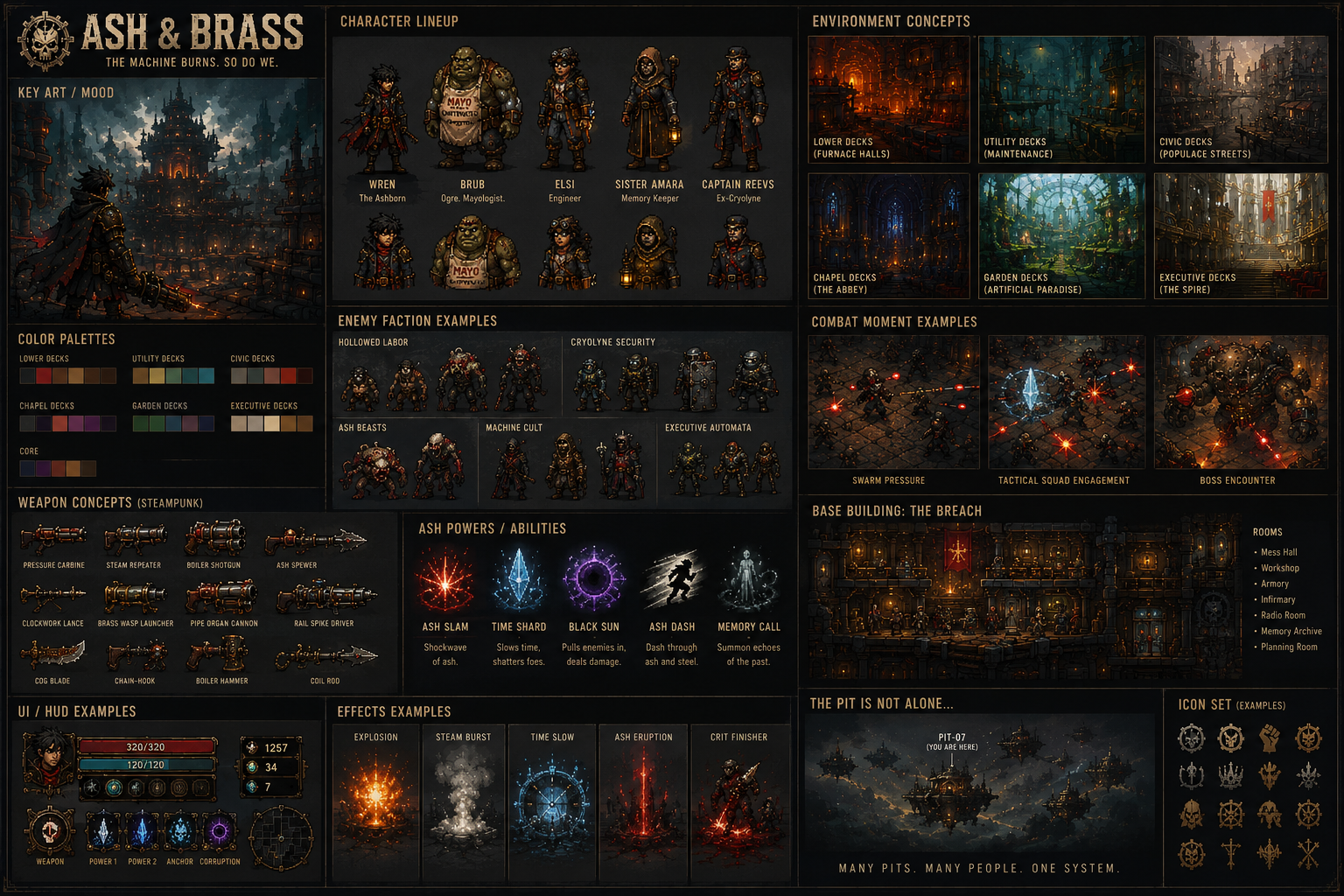
He builds a Forge to repair weapons. An Ash Crucible to unlock powers. A Workshop for gadgets and turrets. A Barracks for rescued survivors. A Med Bay where Vesp patches wounds. A Map Room where Marlow tracks mission routes. An Engine Shrine where Reeves keeps the lights on. And a Memory Archive — the most important room — where the voices of the dead are stored, where Wren learns their stories, their weaknesses, their hope.
[The Loop — Hub and Combat]
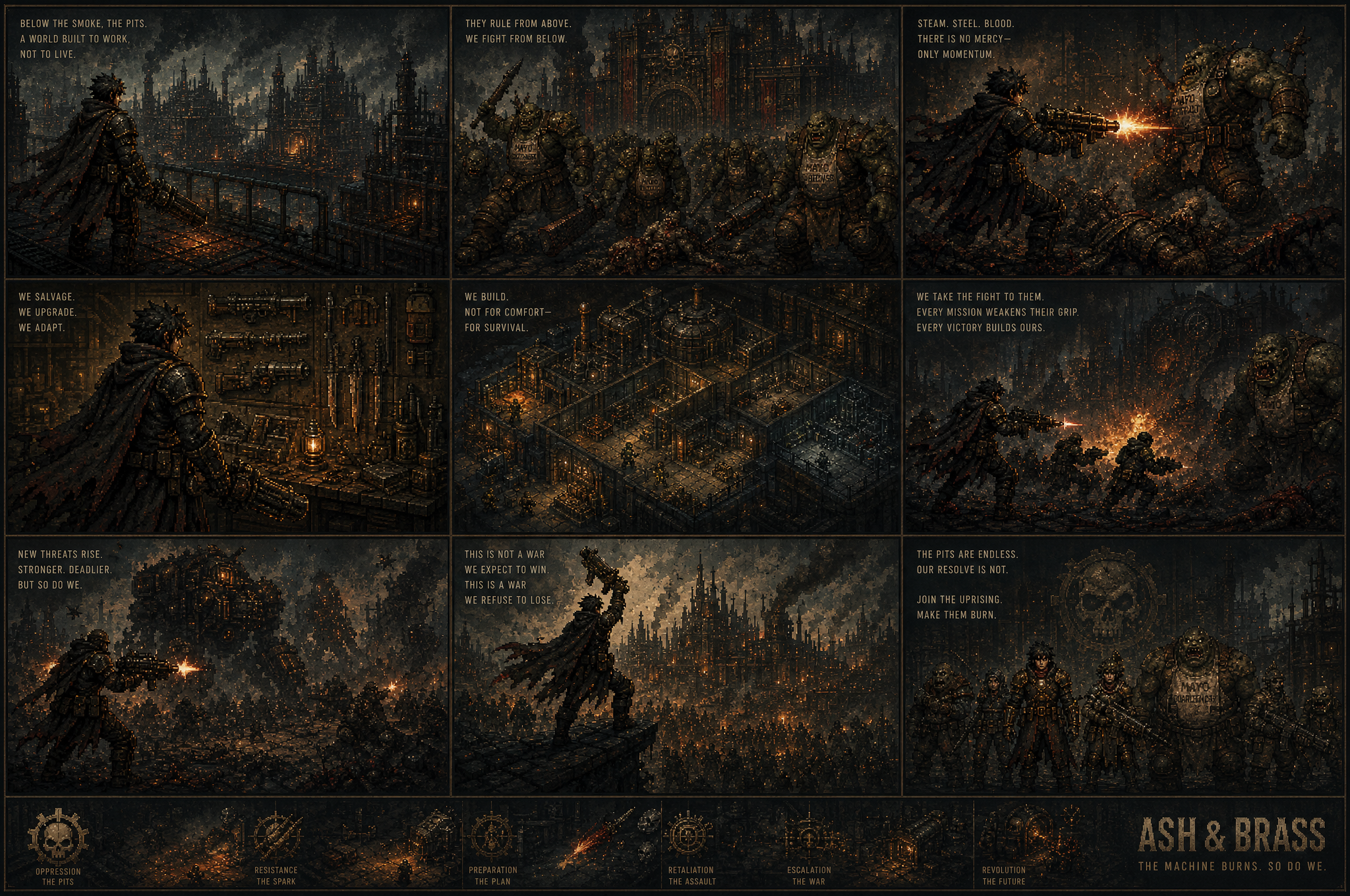
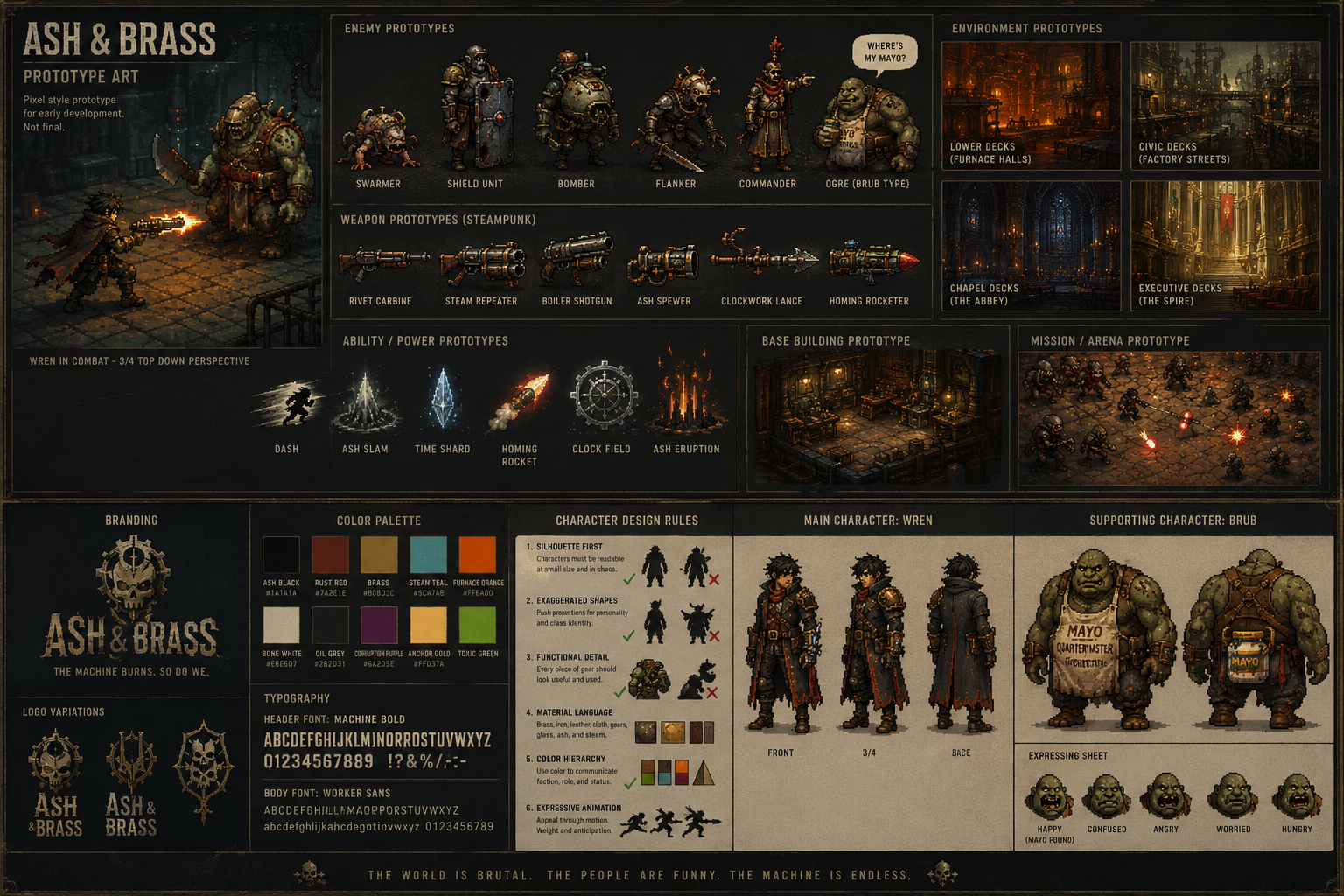
The loop is four steps. Prepare at The Breach. Choose loadout — 1 melee, 1 ranged, 1 heavy weapon, 2 ash powers, 1 armor, 1 relic. Deploy into The Pit's corrupted depths. Fight through hordes with steampunk weapons: pressure carbines, cogblades, boiler hammers, chrono pistols, coil rods, brass wasp launchers, pipe organ cannons. Each weapon family levels through use, unlocking mastery paths and ultimate abilities.
During missions, Wren discovers outposts — secondary safe areas across the decks. Worker hideouts like The Soup Gap, where Auntie Voss feeds runaways and insults everyone. Maintenance shrines like Valve Saint Station, where engineers pray to a pressure valve that has never exploded. Black-market cars, chapel ruins, upper-deck lounges, ash hollows. Each outpost has immediate utility, local quests, and connections back to The Breach. Outposts help you survive the journey. The Breach makes the journey matter.
Extract with rewards or push farther and risk losing everything. Return to The Breach and expand — new rooms, better gear, deeper stories, more survivors. Then The Pit moves forward, new threats appear, and the next run begins.
[Endgame — The Reversal]
When Wren finally reaches the core and speaks the word the shard has been waiting to hear, the machine inverts. The Pit stops eating and starts returning. Grass pushes through rust. Water seeps back into poisoned swamps. Time flows back into the world in waves, uneven and painful, like blood returning to a limb that fell asleep.
But the Hollows do not get the memo. They wander the biomes — wounded, furious, refusing to die. The Dust Riders try to resettle, to farm, to build, but every road needs clearing. Every night needs a watch. Every town needs a wall.
So Wren keeps fighting. Not for pay. Not for survival. Because he is the only one who can walk through the ash and come out whole. Because the echoes in his blood will not rest while their killers still walk. Because he made a promise to people who are not alive to hear it.
The reversal gave the world a second chance. Now Wren has to make sure the world gets to keep it.
[Corruption — The Price of Power]
Every time Wren draws power from the ash, something draws back. Corruption is not a bad meter. It is a temptation system. Four hidden tracks — Ash Hunger, Time Fracture, Machine Bond, Memory Burden — each offering traits with strong benefits and dangerous drawbacks. Blood-Warmed Ash heals on kills but weakens healing pickups. Echo Reflex repeats attacks but slows dodges. Grave Engine ignites enemies but drains ash during pauses. Clockbroken rewinds lethal damage but permanently increases enemy intensity.
Countering corruption is Anchor — how much Wren remains himself. Rescuing survivors, sparing Hollowed, restoring base rooms, listening to Memory Echoes, keeping promises. Anchor does not make him weaker. It gives different strengths. But it also locks forbidden upgrades. The player must constantly ask: "This upgrade is extremely strong... but what is it doing to Wren, the base, and the ending?"
[Settlements — The Idle Rebellion]
Between The Breach and survivor clusters lie crystal spawners — ash-corrupted growths that pump out Hollowed patrols and block passage. Clearing them opens trade routes. Survivors move. Towns form. Camps become markets. Markets become communities with children, festivals, arguments about stolen lunch.
Each connected settlement provides passive benefits: scrap income, ash refinement, survivor recruits, trade goods, intelligence on Hollow movements. The more settlements Wren connects, the stronger the rebellion. Every town that grows is a middle finger to the machine. Every child who learns to read instead of learning to run is a victory no boss fight can match.
[Tone — Tragedy and Mayonnaise]
The world is brutal. The machine is horrifying. But the people inside it are still people — stupid, petty, hungry, and weird. Cryolyne posts mandatory safety posters next to corpse grinders. Employee wellness seminars happen in death factories. Managers blame workers for being consumed. A depressed turret says "Target acquired. Again. Thrilling." An overly professional monster asks "Before I devour your years, I am legally required to ask if you consent to a brief satisfaction survey."
And then there is Brub — a lower-rank ogre assigned to security who is large, terrifying, and extremely bad at his job. He mostly cares about lunch, union rules, and finding the person stealing condiments from the breakroom. He keeps appearing during serious moments by accident. His missing mayo jar contains a hidden memory recording. The funny object becomes heartbreaking. "So... it wasn't about mayo?"
The formula: 70% dark action, 20% absurd workplace comedy, 10% emotional gut punch. The jokes occasionally turn into something meaningful. The meaningful moments are occasionally interrupted by someone asking about mayonnaise.
[Endings — Six Paths]
How this ends depends on who Wren became. Not one final choice — the sum of every trait, every rescue, every burn. The ending is filtered through who he is when he reaches the core.
The Severance — destroys the core without destroying everyone inside. Hard-earned hope. Wren loses his powers or his lifespan collapses.
The Ash King — takes the core for himself. Power fantasy turned tragedy. The people are free from Cryolyne but not from fear.
The Machine Saint — merges with The Pit and redirects it. Bittersweet control. He saves the people but cannot leave.
The Choir — releases the stolen lives from the ash. The dead pass on. Wren may die, vanish, or become a memory himself.
The Hollow — reaches the core but cannot resist it. Becomes the final Hollow, guarding The Pit forever. The next cycle begins.
The Rebellion — does not save everyone alone. The people of The Pit rise with him. The final battle becomes a full rebellion. Best human ending.
The ending is not a cutscene. It is the sum of every choice.
[The Pit as Society — Snowpiercer on Tracks]
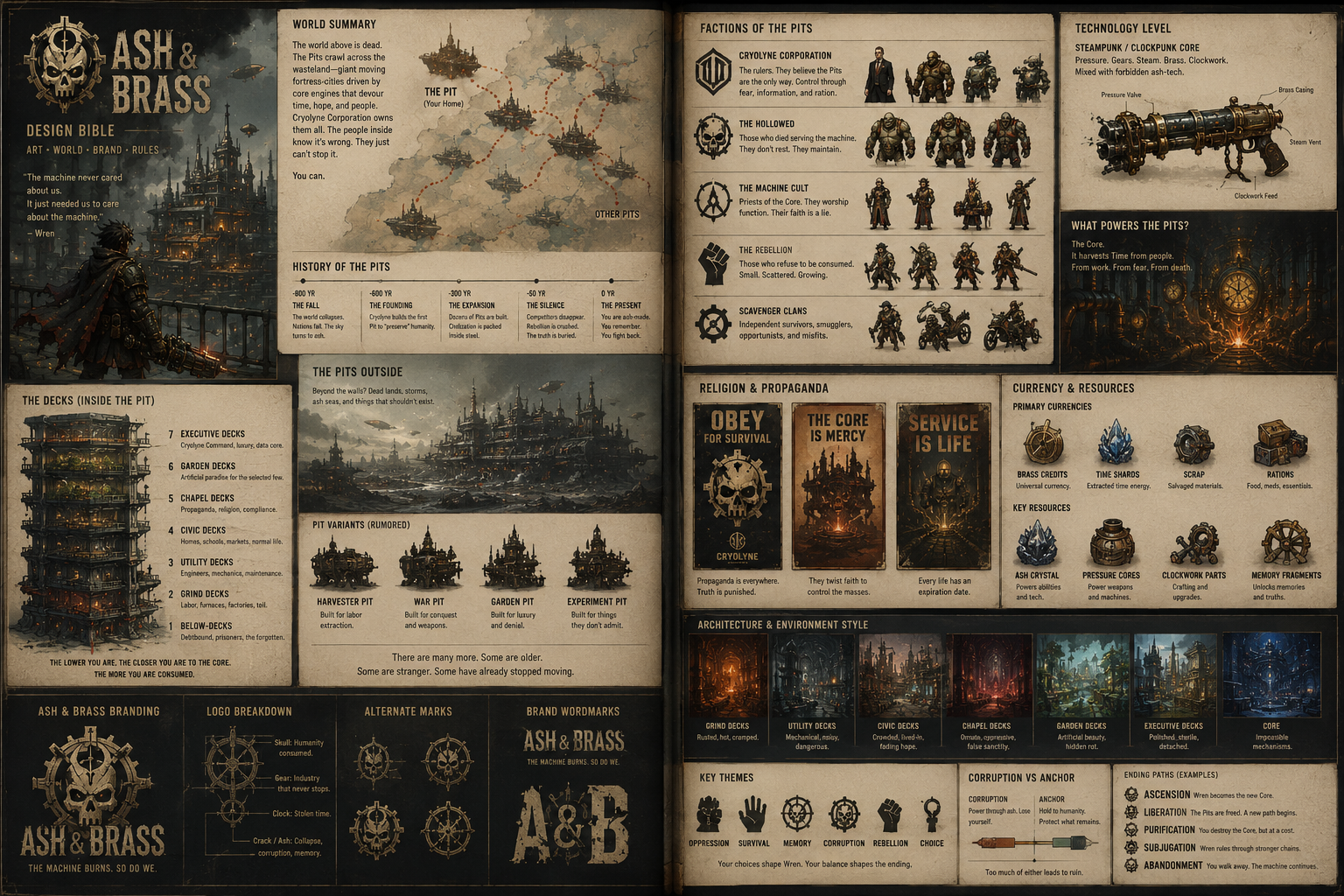
The Pit is not just a machine. It is a society. A crawling fortress-city with seven deck levels, seven classes, and one lie: without The Pit, everyone dies.
Everyone inside knows the truth — or enough of it. They know people disappear. They know the lower decks scream at night. They know Cryolyne is lying. But they also know the Ground outside is worse. Or at least, that is what they have been told. The Pit does not control people by hiding the truth. It controls them by making the truth feel useless. "Everyone knows. Knowing does not open the doors."
The Grind Decks at the bottom — furnace workers, miners, prisoners, debt laborers. Rust, heat, ration lines, ash sickness. Workers argue over stolen soup while the walls bleed. The Utility Decks — engineers, mechanics, machine priests. They understand more than most, but they are complicit because they think stopping The Pit would kill everyone. The Civic Decks — families, teachers, cooks, children. They are not evil. They are scared. They have built small lives inside a giant lie.
The Chapel Decks — where survival was turned into faith. People do not just obey The Pit. They worship it because fear needed somewhere to go. The Garden Decks — artificial paradise for the privileged. Rich people complain about ash ruining brunch while luxury wellness retreats are powered by stolen years. The Executive Decks — polished brass, glass floors, surveillance everywhere. They know. They have always known. They built a language to make murder sound operational.
Cryolyne does not say "we feed workers to the core." They say "end-of-service personnel are transitioned into final utility." They do not say "we steal time." They say "we recover unused temporal value." In The Pit, death is not the bottom. Utility is. Even after someone dies, Cryolyne still finds a way to make them useful.
Wren's role is not to tell people Cryolyne is bad. They already know. His real role is proving that change is possible. Before Wren, people complain, survive, disappear, whisper, and keep working. After Wren, doors open, bosses die, decks connect, forbidden broadcasts spread, and people see The Pit bleed. He becomes dangerous not because he is powerful. He becomes dangerous because he makes hopeless people imagine movement.
[The Five Acts — Deck by Deck]
Act 1: Below. Wren establishes The Breach in the lower decks. Survival. Workers. Ash horror. Basic oppression. Goal: survive and build shelter.
Act 2: Across. Wren connects lower-deck communities. Organizing. Trust. Class division. Sabotage. Goal: build a network.
Act 3: Up. Wren reaches civic and chapel decks. Propaganda. Moral conflict. People who believe the lie. Goal: expose Cryolyne.
Act 4: Above. Wren infiltrates garden and executive decks. Luxury built on suffering. Corporate truth. False salvation. Goal: break leadership control.
Act 5: Down. Instead of going higher, Wren descends to the core. Origin. Sacrifice. Endings. What kind of future replaces The Pit? Goal: decide the fate of the machine.
"The people of The Pit do not need Wren to tell them they are oppressed. They need him to prove the machine can bleed."